
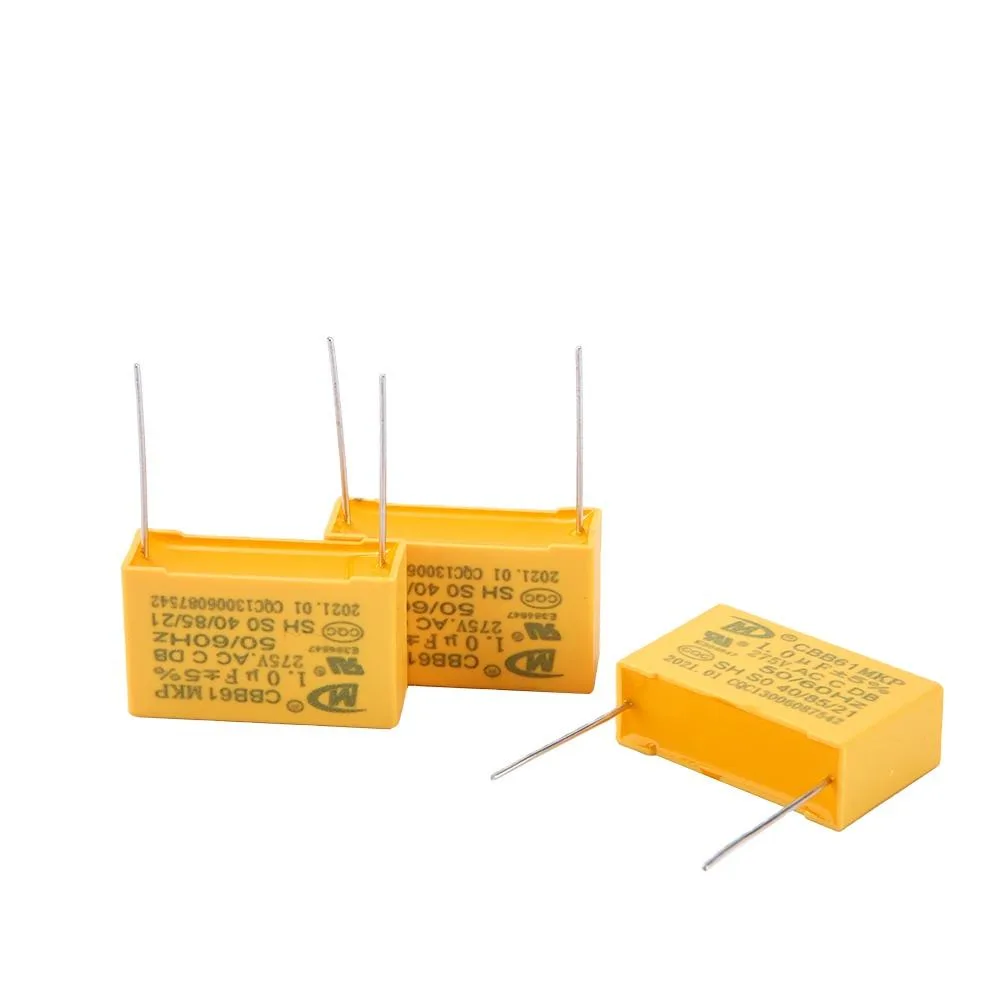
Every switch-mode power supply leaks high-frequency noise back onto the mains. The component standing between that noise and your customer's wall socket is usually an mkp x2 safety capacitor — a metallized polypropylene film capacitor built to fail safely across the line. Get the selection wrong and you'll see anything from nuisance tripping to a charred PCB. Get it right and the part quietly does its job for a decade. This guide walks through the IEC 60384-14 and UL60384-14 Class X2 requirements, the 4.3×UR withstand test, the 100 V/µs dV/dt ceiling, UL94 V-0 resin sealing, and how capacitance holds up in LED drivers, smart meters, and appliance control boards.
What Class X2 Actually Means Under IEC 60384-14 and UL60384-14
Class X capacitors sit across the line — line-to-line, not line-to-ground. That position matters because a failure here puts the full mains potential into a short circuit. IEC 60384-14 defines X2 as the general-purpose across-the-line class, rated for 250/275/310 VAC at 50/60 Hz in typical designs. UL60384-14 mirrors the same safety philosophy for North American approvals. Both standards care about one thing above all: the capacitor must not create a fire or shock hazard when it dies.
That's why X2 parts are self-healing. A dielectric breakdown vaporizes a tiny region of the metallized electrode and clears the fault instead of shorting. The polypropylene film recovers, the capacitor keeps filtering, and your end product stays safe. This is also why you should never substitute a generic DC film capacitor in an X2 socket. The construction looks similar. The safety qualification doesn't.
SMILER's MKP X2 series is rated 250/275/310 VAC (50/60 Hz) with capacitance from 0.1 µF to 3.3 µF, and it's built to IEC 60384-14, UL60384-14, and GB/T 14472-1998. Common across-the-line values — 0.1 µF, 0.15 µF, 0.22 µF, 0.33 µF — cover most EMI filter front ends. You can review the full range on the MKP X2 EMI safety capacitor page.
The 4.3×UR Withstand Test and the 100 V/µs dV/dt Limit
Two numbers separate a real X2 part from a lookalike: the 4.3×UR withstand voltage and the 100 V/µs dV/dt ceiling. The withstand test applies 4.3 times the rated AC voltage in DC for 10 seconds. For a 310 VAC part, that's roughly 1,333 VDC held across the film. It's a brutal screen, and it's there to catch weak spots in the metallization and the film itself before the part ever ships.
The dV/dt limit is the one designers forget. MKP X2 is specified at 100 V/µs maximum. That's the rate of voltage change the internal electrode and contact structure can handle without localized heating at the end connections. Push past it — say with a fast transient or a poorly damped switching node — and you'll erode the contact metallization over time. The capacitor won't fail on day one. It'll drift, lose capacitance, and eventually open or short. Keep your worst-case line transients inside 100 V/µs and the part stays in its comfort zone.
Here's how the MKP X2 series lines up against the wider SMILER film capacitor family for context:
| Parameter | MKP X2 (Safety) | MKP-AM (AC Filter) | MKP-LM (DC-Link) |
|---|---|---|---|
| Rated voltage | 250/275/310 VAC | 250/310/350/400 VAC | 500–1200 VDC |
| Capacitance range | 0.1–3.3 µF | 0.1–40 µF | 1–110 µF |
| dV/dt limit | 100 V/µs max | Application-dependent | Application-dependent |
| Withstand test | 4.3×UR (VDC)/10 s | 1.5×VR (10 s) | 1.5×VR (10 s) |
| Encapsulation | Flame-retardant case, epoxy | PCB, 2/4 pins | PCB, 2/4/6 pins, UL94 V-0 |
| Standard | IEC 60384-14, UL60384-14 | IEC 61071:2007 | IEC 61071 |
| Typical use | Across-the-line EMI | AC output filtering | DC bus support |
Across-the-Line Differential-Mode Filtering in Practice
An X2 capacitor across L and N forms the differential-mode leg of your EMI filter. It shunts high-frequency current that would otherwise ride the mains wiring. Pair it with a common-mode choke and you've got the classic two-stage front end found in almost every offline power supply. The X2 part handles the line-to-line noise; the choke and Y-caps handle common mode.
Value selection is a trade-off. A larger X2 capacitance gives better low-frequency attenuation but draws more reactive current at 50/60 Hz and increases inrush energy. For a 100 W LED driver, 0.22 µF to 0.47 µF is a common starting point. For a 1 kW appliance board, you might land near 1 µF. Watch the leakage current budget too — X2 parts don't contribute to earth leakage, but the Y-caps next to them do, and the combination has to clear your safety limit.
Layout matters as much as value. Keep the X2 loop short and tight to the input connector. Long traces add inductance that kills high-frequency performance and can push local dV/dt higher than your calculation assumed. A compact loop also reduces the antenna area that radiates your switching noise back out.
UL94 V-0 Resin Sealing and Capacitance Stability
MKP X2 uses a flame-retardant plastic case with epoxy resin sealing, and the resin system meets UL94 V-0. That rating isn't decoration. In an across-the-line position, a flame-retardant enclosure and potting compound limit the chance that a fault propagates into a fire. The epoxy also blocks moisture ingress, which is the quiet killer of film capacitor stability.
Moisture drives capacitance drift and insulation resistance loss. A well-sealed X2 part holds its value through humidity cycling, which is exactly what you need in an LED driver mounted in a damp luminaire or a smart meter sitting on an outdoor wall. SMILER runs a dedicated QA/QC team and in-house lab with leak testing and DC withstand voltage screening on every batch, holding a ≥99.93% finished product qualification rate. You can read more about the process on the quality page.
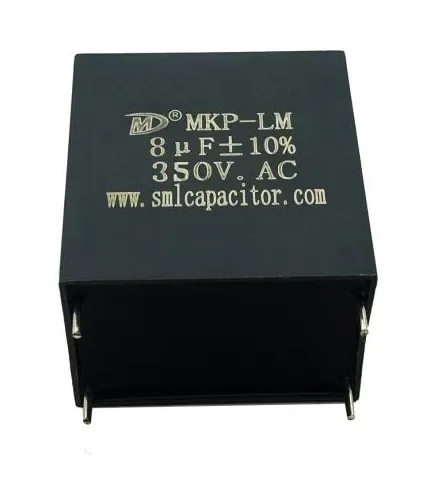
For designs that face harsher humidity — outdoor smart meters, tropical installations — it's worth asking about the broader SMILER portfolio. The MKP-LM THB-Type uses a PPS high-temperature case and passes 1,000 h at 85°C/85% RH with rated voltage applied, holding |ΔC/C| ≤ 10%. That's a DC-link part, not an X2 substitute, but it shows the sealing discipline the company applies across product lines.
Where MKP X2 Earns Its Place: LED Drivers, Smart Meters, Appliance PCBs
Three applications dominate X2 demand, and each stresses the part differently.
LED drivers. These run hot and compact. The X2 capacitor sits near the input rectifier, absorbing differential-mode noise from a fast switching stage. Capacitance stability matters because a drifting X2 value shifts your EMI filter corner and can push you out of compliance late in the design cycle. The 100 V/µs limit is the guardrail here — keep the input transient environment tame and the part holds its value.
Smart meters. Long field life, wide temperature swings, and humidity. A meter might sit on a pole for 15 years. The X2 part has to keep filtering without drifting enough to affect the metering front end or the communications radio. UL94 V-0 sealing and stable polypropylene dielectric are what carry you through that service life.
Appliance control boards. High-volume, cost-sensitive, and safety-critical. Washing machines, induction cookers, and air-conditioner boards all use across-the-line X2 filtering. SMILER supplies appliance-tier customers including Midea, Nidec, Airmate, and Home Depot, and the MKP X2 series is built for exactly this kind of PCB-level EMI suppression.
If you're specifying for any of these, the practical checklist is short: confirm the X2 class and standard, verify the 4.3×UR withstand and 100 V/µs dV/dt, check the UL94 V-0 sealing, and validate capacitance stability over your actual humidity and temperature profile. Then talk to the factory about your volume and customization needs — SMILER supports OEM/ODM capacitance, voltage, case, and pin configurations, with sample lead times as short as 5 days. Reach the team through the contact page.
Frequently Asked Questions
Can I use a regular DC film capacitor instead of an MKP X2 part across the line?
No. A DC film capacitor isn't qualified to IEC 60384-14 or UL60384-14 for across-the-line duty. It hasn't passed the 4.3×UR withstand screen, and its failure mode under line voltage isn't controlled. X2 construction is designed to fail safely — use a certified X2 part or don't put a capacitor there at all.
What does the 100 V/µs dV/dt limit actually protect?
It protects the internal electrode-to-contact structure from localized heating and metallization erosion. Exceed it repeatedly and the capacitor drifts in capacitance before eventually failing. Keep worst-case line transients under 100 V/µs and the MKP X2 part stays within its designed operating envelope.
How stable is MKP X2 capacitance in humid LED driver or smart meter environments?
The polypropylene dielectric plus UL94 V-0 epoxy sealing resists moisture-driven drift. For extreme humidity, ask about the wider SMILER portfolio — the MKP-LM THB-Type, for example, is validated at 1,000 h of 85°C/85% RH with rated voltage and holds |ΔC/C| ≤ 10%. Match the sealing level to your actual field conditions.
Related Capacitor Series
Need Datasheets or Custom OEM Film Capacitors?
Send your capacitance, voltage rating, and mechanical drawing. Our 9-member engineering team replies within 24 hours with 5-day prototyping availability.